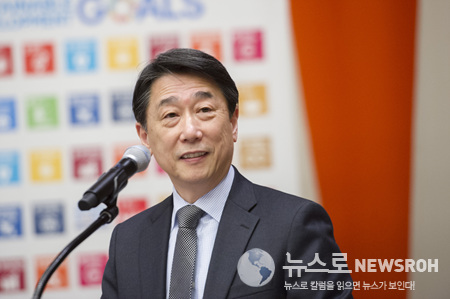
오준 유엔 경제사회이사회(ECOSOC) 의장이 30일 불평등에 대한 ECOSOC 특별회의를 주재했다.
오준 의장은 개회사를 통해 "경제 발전과 빈곤 감소 등 국제 사회의 성과에도 불구하고 불평등은 오히려 심화(深化)되었다"며, 이는 전 세계적으로 진행되고 있는 보편적 현상임을 강조했다. 소득 및 부의 격차가 확대되고 있을 뿐 아니라, 인간의 삶에 필수적인 기본적인 요소들에 대한 접근성과 관련된 불평등도 작용하면서 빈곤의 악순환 등 문제가 악화되고 있다는 것이다.
오준 의장은 "이러한 상황에서 유엔과 같이 공공선(公共善) 증진을 추구하는 기관에서 불평등 문제를 논의할 필요가 있다"며, "이번 특별회의를 통해 불평등 문제에 대한 다양한 의견을 나누고 나아가 이행 초기 단계인 2030 개발의제 달성에도 기여할 수 있기를 희망한다"고 밝혔다.
이날 특별회의는 오준 의장과 얀 엘리아슨 유엔 사무부총장이 참석한 가운데 기조 연설 및 3개 토론 세션으로 진행되며 정부, 국제기구, 학계, 시민사회의 다양한 인사들이 참석했다. 기조연설은 한승수 전 총리와 레베카 카다가 우간다 국회의장, 리카르도 카르도나 온두라스 사회개발포용 장관이 맡았다.
31일 열리는 'ECOSOC 파트너십 포럼'은 2008년부터 매년 개최되고 있으며, 다양한 이해관계자들이 회원국, 유엔 기구 등과 함께 지속가능개발목표(SDGs) 등 국제사회가 합의한 목표들의 이행 지원 방안에 대한 정책 논의 기회를 제공해 왔다.
뉴욕=민지영기자 newsroh@gmail.com
<꼬리뉴스>
Opening remarks by H.E. Oh Joon
President of the Economic and Social Council
Special Meeting of the Economic and Social Council on Inequality
30 March 2016, ECOSOC Chamber
Excellencies,
Distinguished Delegates,
Dear Colleagues,
Ladies and Gentlemen,
I have the honour to welcome you to the Special Meeting of the Economic and Social Council on Inequality.
Some might ask, “why does the UN need to discuss inequality now?”
Over the last few decades, poverty rates have declined in every region of the world; emerging market economies have grown with unprecedented speed; and life-changing technologies have dramatically improved our standards of living.
However, the numbers clearly show that gaps in income and wealth have been growing consistently around the world. Today, seven out of 10 people in the world live in countries where income inequality has risen, in many cases, to the highest level in 30 years. It has become a cliché to say that the richest 1% has come to possess more than half the total wealth of the world.
Here in NYC, we all witness these dramatic contrasts quite often on the streets, where homeless people, with only ragged blankets to survive the winter, are seen lying underneath a window showcasing luxury dresses priced at thousands of dollars,.
Inequality is more than an issue of income and wealth disparities. It is compounded by unequal access to basic human needs such as food, healthcare, education, drinking water, and sanitation.
Around the world, women in rural areas remain three times more likely to die in childbirth than those in urban areas; and children born in poorer households are less likely to complete their primary education.
When we see all of these, we realize that something may be seriously wrong; that if such trends continue, our communities will have to suffer social and political instability, often providing a breeding ground for extremism.
The international community has long fought against poverty and hunger. We have had some success. Still, the fact that the gaps between the rich and poor are widening, despite improvements for the poorest, indicate that there are structural elements which cannot be properly dealt with by poverty reduction efforts alone.
Whether you call those elements ‘the rules of the game’ or ‘a level-playing field’, they need be discussed at the United Nations, which is our shared forum in pursuit of global public goods.
That is why we are here. We are here to deal with inequality as a fundamental and universal challenge, affecting all countries and people in the world.
Last September, when adopting the 2030 Agenda for Sustainable Development, the Member States of the United Nations committed ourselves to reducing inequality and to leaving no one behind. Addressing inequality is incorporated in the 2030 Agenda, as a standalone goal in Goal 10 and as well as a crosscutting objective all over the Agenda.
This ECOSOC Special Meeting comes at the very first phase of the implementation of the 2030 Agenda. We are still working out our concrete plans to fulfil our pledges. Your insights and ideas to be presented today on how to address inequality would therefore be most welcome.
I am sure that all of us in ECOSOC and the United Nations will benefit from them at a time when we need guidance in our long journey. Thank you. /End/

 뉴욕 :
뉴욕 :  파리 :
파리 :  서울 :
서울 :